

The Prime Minister has assigned the Ministry of Construction to study CT Group’s proposal for the Ho Chi Minh City – Can Tho – Ca Mau railway project and to guide the enterprise in implementing it in accordance with legal regulations.

The Government Office has recently sent an official document to the Minister of Construction to convey the Prime Minister Pham Minh Chinh’s instructions concerning the proposal by CT Group Joint Stock Company to prepare a pre-feasibility study report and to seek approval in principle for investment in the construction of the Ho Chi Minh City – Can Tho – Ca Mau railway line under the public–private partnership (PPP) model.
Accordingly, the Prime Minister assigned the Ministry of Construction to study CT Group’s proposal and to guide the enterprise in its implementation in accordance with legal regulations; ensuring fundamental principles and implementation conditions in the spirit of openness and transparency, harmonized interests (among the State, the people, and enterprises), and risk sharing.
Previously, in October, CT Group had sent an official document to Prime Minister Pham Minh Chinh proposing to prepare a pre-feasibility study report and to seek an investment policy for the construction of the Ho Chi Minh City – Can Tho – Ca Mau railway project.
According to CT Group’s proposal, the Ho Chi Minh City – Can Tho – Ca Mau railway line would be developed as a double-track, electrified railway with a 1,435-mm gauge, serving both passenger and freight transport, with a design speed of 200–250 km/h; at the same time, an additional option with a speed of 300–350 km/h would also be studied.
The project’s starting point is Thu Thiem Station in Ho Chi Minh City; the Phase 1 terminal is Cai Rang Station in Can Tho City, and the Phase 2 terminal is Dat Mui Station in Ca Mau Province. The railway line is expected to be approximately 160 km in length in Phase 1 and about 120 km in Phase 2, passing through six provinces and cities, namely Ho Chi Minh City, Tay Ninh, Dong Thap, Vinh Long, Can Tho, and Ca Mau.
Regarding the financial mechanism, a representative of CT Group stated that the group would coordinate with reputable international partners to mobilize investment capital, with a preliminary total investment of approximately USD 12 billion (excluding costs for compensation, support, relocation, and resettlement for site clearance).
CT Group proposes to self-finance the preparation of a pre-feasibility study report and to participate in the investment and construction of the railway line under the PPP model, in which 80% of the total investment capital would come from the State Budget across medium-term public investment plans and other lawful sources, while the remaining 20% would be funded by the investor’s equity and other legally mobilized capital.
The Group plans to contribute approximately 75% of the revenue from land development projects, including 400 hectares near Tan Kien Station (former Binh Chanh District, Ho Chi Minh City), 200 hectares in the Can Tho railway urban area, and 200 hectares in the Ca Mau terminal station area, equivalent to approximately VND 250 trillion.
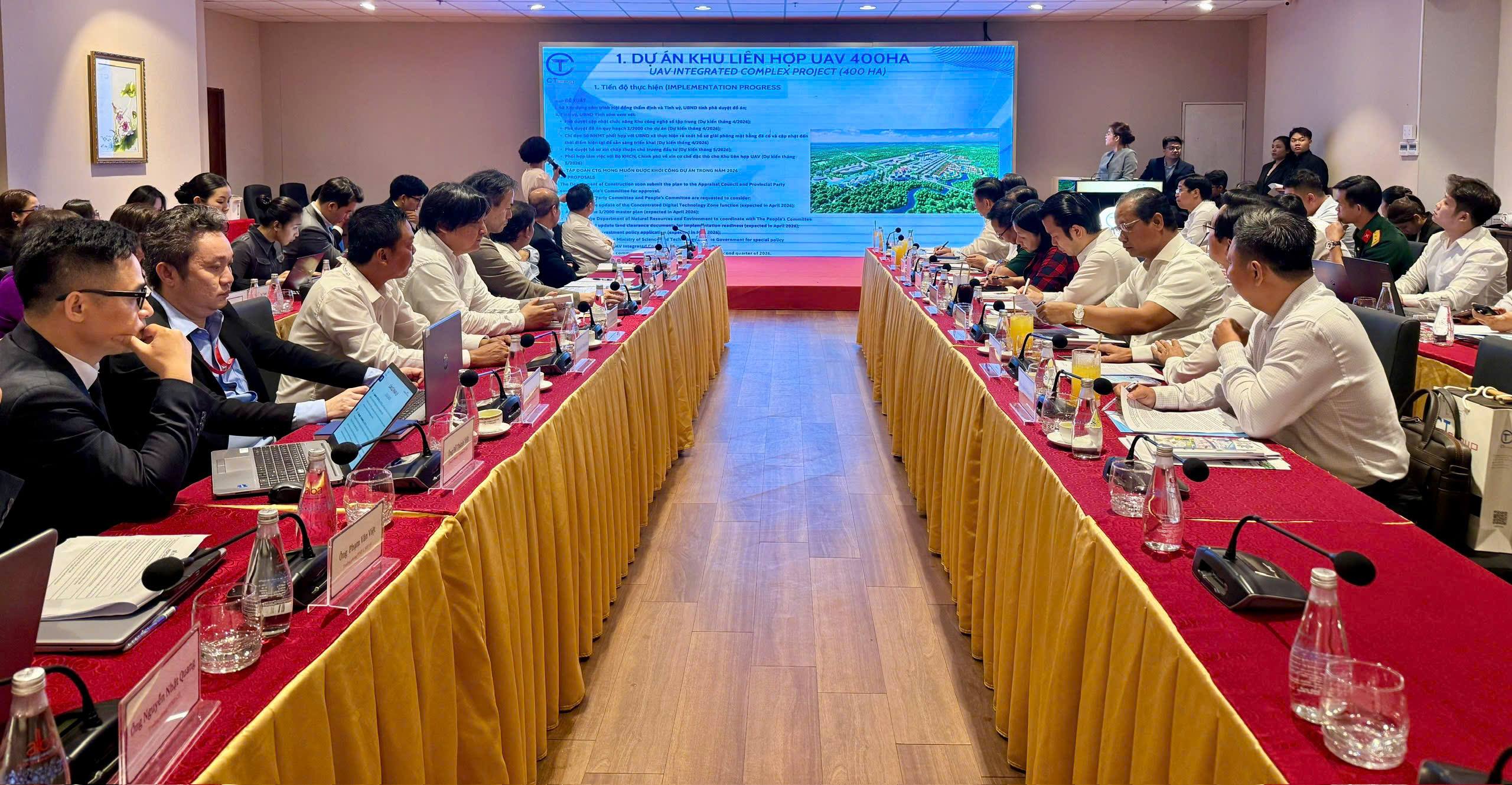
A representative of CT Group stated that the Group has signed a contract with the China Railway Design Corporation (CRDC) to conduct studies and prepare the pre-feasibility study report for the project.
If approved by the competent authorities, CT Group will complete the pre-feasibility study report during the 2025–2026 period; prepare the feasibility study report and the environmental impact assessment during 2026–2027; commence construction in 2027; and complete the project and put it into commercial operation in the 2031–2032 period.
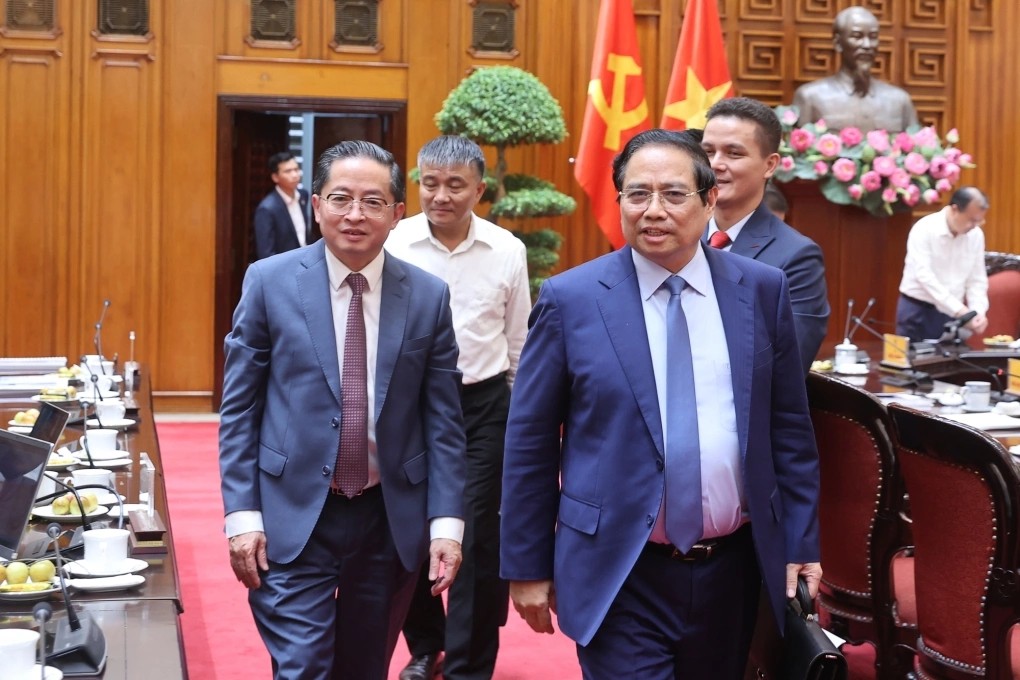
Prime Minister Pham Minh Chinh at a working session with representatives of CT Group
CT Group was founded in 1992 by Mr. Tran Kim Chung, initially under the name Saigon Trading Co., Ltd. In 2006, the Group was formally established, expanding into a diversified multi-sector system, and currently has more than 68 member companies spanning fields from real estate to high technology.
Currently, the enterprise is focusing on nine core Industry 4.0 technology sectors: semiconductor technology; unmanned aerial vehicles (UAVs); artificial intelligence (AI); ESG solutions with carbon credits; green digital currency; electric vehicles and unmanned rail vehicles; new energy; gene and cell technology; and quantum technology.
On August 12, the Group drew attention by signing a cooperation agreement with Airbility to export 5,000 unmanned cargo aerial vehicles (UAVs). It will also carry out ATP (assembly–testing–packaging) for 100 million semiconductor chips for Imagis. Previously, the Group had broken ground on the expansion of its chip manufacturing facility and set a target of producing 100 million chips per year by 2027.
At a working session with CT Group in August, Prime Minister Pham Minh Chinh highly commended the Group’s proactiveness in its investment and development programs, noting that its projects and strategic directions are well aligned with Vietnam’s core technology development strategy.
The head of the Government urged CT Group to continue its strong engagement in science and technology, innovation, and digital transformation; to contribute feedback toward improving mechanisms and policies; and to implement projects in the spirit that “what is said must be done, what is done must deliver concrete, measurable products and results.”
________________________
Theo dõi CT Group trên Facebook để cập nhật thêm thông tin và tin tức mới nhất!