

While many countries are still experimenting with single UAVs for firefighting operations, a Vietnamese conglomerate has successfully developed a swarm UAV firefighting system that can operate effectively in deep alleys, narrow lanes, and high-rise buildings, areas that fire trucks cannot reach.
A series of major fires have occurred in densely populated residential areas located in narrow alleys and deep lanes in Hanoi and Ho Chi Minh City, causing devastating losses of lives and property.
In early April 2025, in Xom Cui Ward, District 8 (former), Ho Chi Minh City, a fierce fire broke out in a house, killing three people. Firefighting forces faced significant difficulties as the house was located deep inside a narrow alley with no secondary emergency exit, while residents were unable to control the flames using on-site measures. Less than two weeks later, on April 13, another tragic fire occurred at Alley 14, Lane 69 Trung Liet Street, Dong Đa District (former), Hanoi, claiming the lives of two people. The area where the fire broke out is a narrow alley densely populated with residents. On April 28, a house fire that broke out at dawn in Hoàng Mai District (former), Hanoi, claimed three more lives. The house was located deep inside a small alley with no secondary emergency exit, creating difficulties for rescue teams. The fire engulfed the house within just a few minutes, leaving the victims with no time to escape.
There are also the painful memories of devastating fires that occurred in 2023. One was the fire at a mini apartment building located deep in a narrow alley on Khuong Ha Street, Thanh Xuan District (former), Hanoi, which claimed 56 lives. Another was a boarding house fire in a deep alley at 43/98/31 Trung Kinh Street, Trung Hoa Ward, Cau Giay District (former), Hanoi, which resulted in 14 fatalities.
While many developed countries such as China, South Korea… have begun experimenting with single firefighting UAVs, CT UAV (A member of CT Group) has developed a swarm UAV solution for firefighting operations. This is the first swarm firefighting UAV system in Vietnam, using AI to control a fleet of UAVs that can quickly reach and effectively handle fires deep inside narrow alleys and small lanes.
A Fire Swarm system consists of dozens of UAVs operating in coordination like a tactical aerial formation. Among them, a command UAV acts as the “battlefield commander”, equipped with LiDAR, thermal cameras and an AI chip. The command UAV continuously builds a thermal map to accurately determine the location and direction of the fire’s spread.
The remaining UAVs, called Attacker UAVs, are directly responsible for firefighting, rescue operations and other critical tasks. Each UAV can carry water, firefighting chemicals or specialized fire-extinguishing balls. When receiving commands from the command UAV, the entire formation automatically divides the approach angles, calculates collision-free flight paths, and simultaneously sprays water, releases chemicals or drops fire-extinguishing balls onto the fire source. However, a fire cannot be extinguished in just a single attempt. Therefore, CT UAV has designed the Fire Swarm system to operate in an automated cyclical process. This process is continuously repeated until the fire is completely extinguished. In tests conducted in early March 2026, a fleet of five UAVs operated continuously for 45 minutes, completing 12 cycles of attack and water refilling until the simulated fire was fully put out.
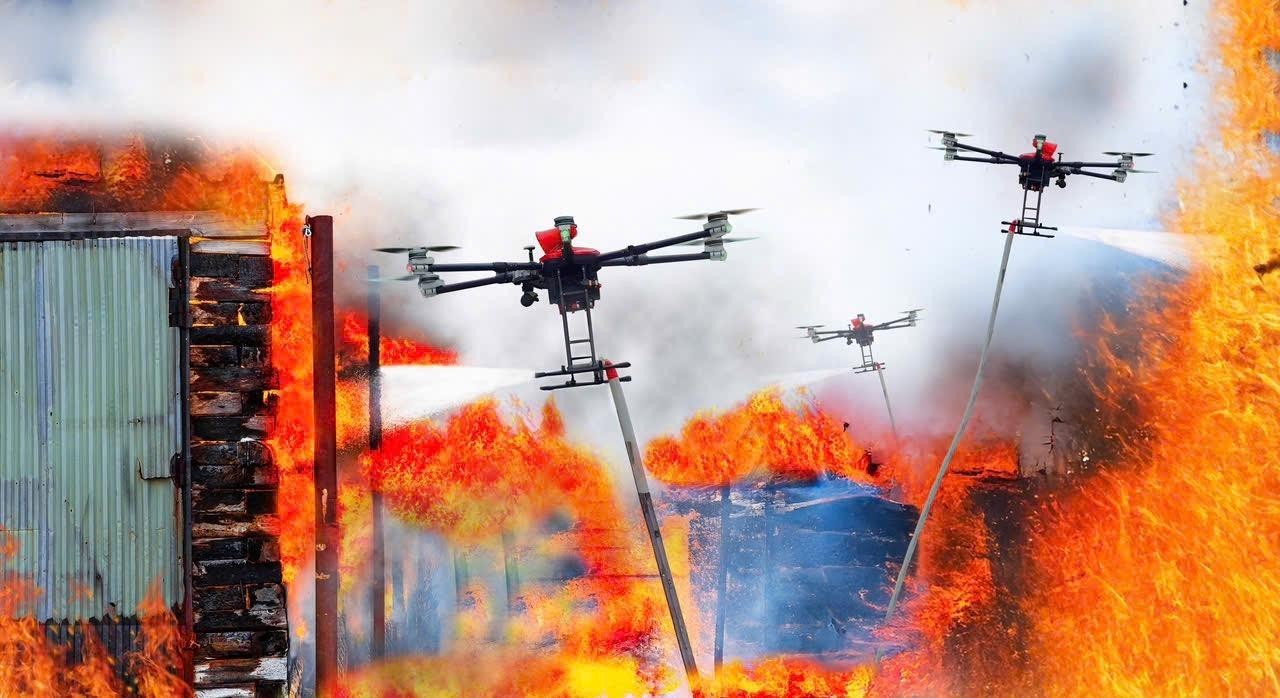
The command UAV can coordinate and direct a fleet of firefighting UAVs present at the scene according to an optimal firefighting and rescue scenario that has been trained into the AI firefighting system.
In addition to firefighting, the UAVs in the swarm system can perform various rescue tasks to provide timely emergency assistance. They can broadcast instructions to residents through high-power loudspeakers, use powerful LED lights to illuminate escape routes from above, since electricity in fire zones is often cut off and project laser signals to guide safe evacuation paths. Moreover, the UAVs can drop gas masks, fire-resistant jackets, and fire extinguishers to help trapped victims stay safe while waiting for professional rescue teams. Currently, CT UAV is also developing heavy-duty rescue UAVs equipped with safety pods capable of evacuating injured victims from fire scenes. These UAVs can also deploy firefighting robots onto the ground and robotic arms to break doors and support rescue operations.
In addition to deep alleys and narrow lanes, CT UAV has also developed firefighting UAV equipment for high-rise buildings reaching up to 300 meters in height equivalent to a 90-story building, areas that conventional fire trucks are unable to reach.
Scientists at CT UAV have created a remarkable technological breakthrough inspired by the haunting cries heard during numerous devastating fires. It is time for us to firmly say no to the terrible loss of lives and property suffered by the people. Nothing is more precious than human life!
________________________
Follow CT Group on Facebook for the latest updates and news!