

Unmanned Aerial Vehicles (UAVs) – a specific application within the low altitude economy (LAE) ecosystem are currently the focus of development investment by Vietnamese businesses. This is due to the sector’s vast economic potential, affirming a strong determination to master the technology supply chain and apply technology to daily life.
Initial potential
The Low-Altitude Economy (LAE) is a concept that refers to economic activities taking place in airspace below 1,000m, and potentially extending up to 5,000m. This space, which has historically been under-utilized, is now becoming a fertile “new land” thanks to manned and unmanned aerial technologies (UAVs). Consequently, its applications range from precision agriculture, smart logistics, and environmental monitoring to telecommunications and entertainment.
Many businesses recognize that, with the guidance from Resolution No. 57-NQ/TW on breakthroughs in science, technology, innovation, and national digital transformation, and the Prime Minister’s Decision No. 1131/QĐ-TTg on the list of strategic technologies and strategic technology products, LAE will play an increasingly vital role in the near future.
Globally, the LAE market has reached a scale of hundreds of billions of US dollars, growing by 30% annually, and is identified as a strategic industry by major economies such as the US, China, and Europe. China launched its LAE development in 2023 with an initial scale of approximately $69.8 billion. This market size is forecast to exceed $500 billion by 2025.
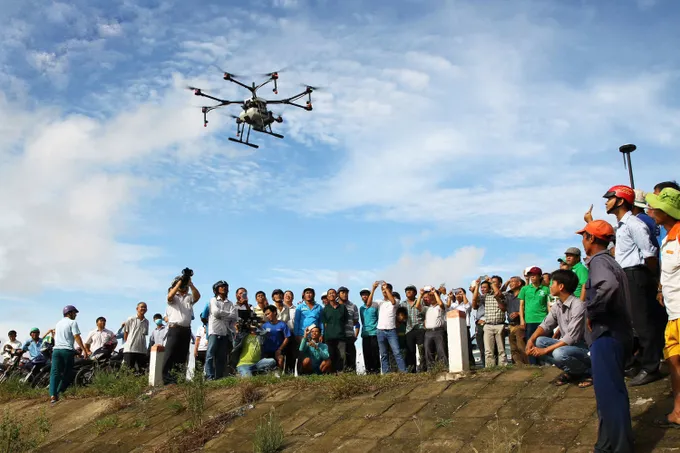
Farmers in Thap Muoi commune, Dong Thap province, experiencing a drone for agricultural production.
In Vietnam, the potential of LAE is estimated to reach $10 billion. With policies encouraging innovation and a young, dynamic workforce, Vietnam is positioned to become the low-altitude industry hub of the region. Initial positive signs of LAE in Vietnam have already appeared across various sectors.
UAVs have been tested for relief deliveries in Thai Nguyen, Tuyen Quang, and Bac Ninh, and for automated delivery at the Lang Son logistics hub. These tests helped shorten time, reduce costs, and overcome topographical limitations. These trials demonstrate the feasibility of low-altitude logistics, especially as Vietnam’s e-commerce market is forecasted to reach $63 billion by 2030.
Expectation to open up a new economic sector
From a production perspective, Mr. Tran Kim Chung, Chairman of CT Group Vietnam, stated that the low-altitude space economy is not a standalone sector but a comprehensive economic ecosystem, integrating both green and digital economy elements.
In agriculture, one UAV can spray pesticides and monitor 67 hectares of crops daily. In the electricity sector, one hour of UAV work can be equivalent to three man-days for a worker inspecting power lines. The leap in productivity is not just a few dozen percent but tens of times over, which is a key factor enabling economies to develop.
Mr. Tran Kim Chung believes that developing LAE in Vietnam will bring numerous strategic benefits, such as generating significant added value, as LAE reflects the ground economy into the air, covering every sector from agriculture, logistics, and construction, and the combination of these fields will continue to create new business models.
Furthermore, LAE will provide effective tools to address major national challenges such as food security, traffic congestion, environmental pollution, and climate change response. LAE is also an economy that integrates many high-technologies, and by mastering it, Vietnam will not only master the technology chain but also achieve a distinct position on the international stage.
________________________
Follow CT Group on Facebook for the latest updates and news!