

Secretary of the Ho Chi Minh City Party Committee, Tran Luu Quang, stated that the city is ready to pilot special financial mechanisms to support the startup and innovation ecosystem.
On the afternoon of December 9, the Ho Chi Minh City leadership’s dialogue with the science–technology and innovation–startup community took place under the chairmanship of Secretary of the Ho Chi Minh City Party Committee Tran Luu Quang.
Contributions from the “leading cranes” of the technology sector
Secretary Tran Luu Quang expressed his deep concern as he directly raised key issues with the business community and scientists. He emphasized that the city is seeking solutions to two major questions.
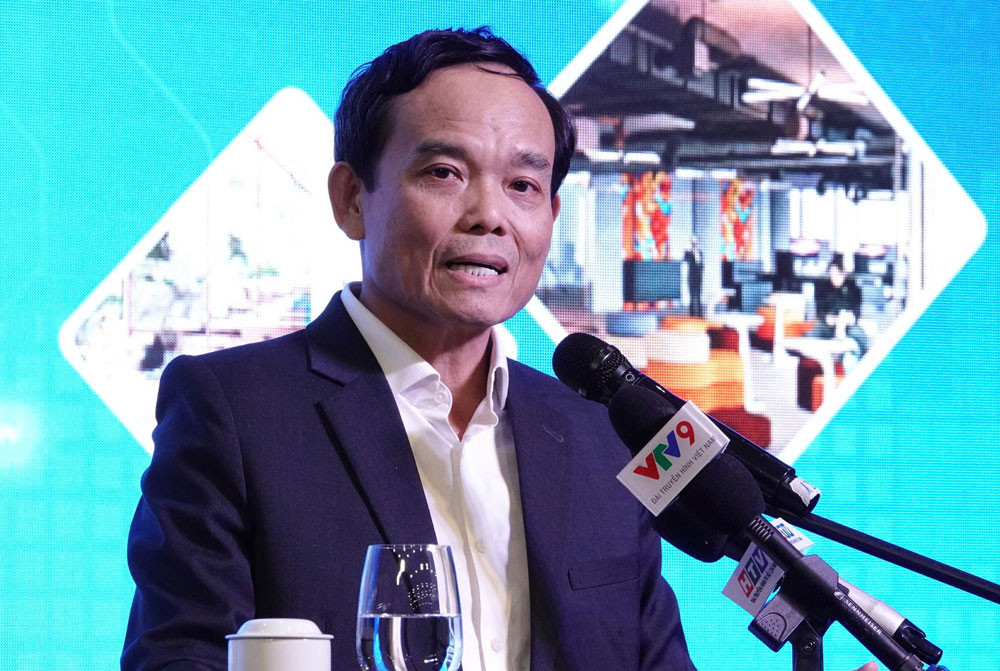
Ho Chi Minh City Party Secretary Tran Luu Quang engages in a dialogue with the science–technology community and the startup–innovation ecosystem. Photo: T.N
The first major question is how Ho Chi Minh City can become a national hub for science, technology, innovation and digital transformation, firmly assuming a leading role. The second, to realize this aspiration, where should the city begin, what should be prioritized, and what resources are required?
Responding to these concerns from the city’s leadership, Mr. Truong Gia Binh – Chairman of FPT Corporation, shared strategic insights from Japan. He noted that Japan is shifting its cooperation focus strongly toward Southeast Asia, with Vietnam as the top priority, especially in the field of Low Altitude Economy (LAE).
However, he emphasized that Vietnam currently faces a major obstacle: a complete lack of institutional frameworks. “We have no definition of what a sandbox is, no standards or regulations, no licenses, no certificates of origin, we lack everything,” he stated.
Despite these challenges, the FPT Chairman remained optimistic, proposing that Ho Chi Minh City should become the capital of unmanned aerial vehicles (UAVs), with the ambitious goal of reaching a market size of 10 billion USD and creating 1 million jobs within the next 10 years.

Mr. Truong Gia Binh – Chairman of FPT Corporation. Photo: TN
Dr. Luong Viet Quoc – CEO of Real-time Robotics provided compelling evidence of Vietnamese capabilities in this field, recounting the proud story of a “Made in Vietnam” drone that impressed U.S. military officers at an exhibition in Las Vegas, something even major global tech powers have yet to achieve.
According to him, Vietnamese engineers are fully capable of producing world-class UAVs. With R&D costs only 1/20 and manufacturing costs 30–40% lower than those in the United States, Dr. Quoc believes there is no reason Vietnam cannot compete on equal footing in the global market.
From another perspective, Mr. Tran Kim Chung – Chairman of CT Group, proposed a model of a “profitable innovation center” built on AI, Web3 and Blockchain. This represents a fresh approach compared to the traditional non-profit incubator models commonly seen.
He explained that under this model, ideas at every stage of innovation can be converted into digital assets, while AI helps connect creators with interested customers and valuation as well as transactions are automated, creating a highly efficient and scalable system.
Mr. Chung also suggested applying a franchise mechanism to expand the model rapidly, enabling Ho Chi Minh City to develop numerous profitable innovation centers.
Sharing the same vision of transforming Ho Chi Minh City into a high-tech hub, Mr. Nguyen Trung Chinh – Chairman of CMC Corporation, emphasized the importance of attracting large-scale data infrastructure investment.
He noted that international partners are ready to increase their Data Center investment from USD 1 billion to USD 5 billion if Ho Chi Minh City is determined to become a regional AI Hub or Digital Hub.
Mr. Chinh proposed that the city establish a strong, decisive implementation apparatus, even recommending the creation of “chief architects” for each specialized field to address complex urban challenges such as flooding, traffic congestion and pollution,… through AI-driven solutions.
Commitment to action driven by real-world demands
To realize these ambitious goals, human resources and knowledge connectivity are the decisive factors. Prof. Dr. Nguyen Thi Thanh Mai – Vice President of Vietnam National University, Ho Chi Minh City, proposed that the city assign the institution the role of coordinating the intellectual resources of universities and research institutes across Ho Chi Minh City.
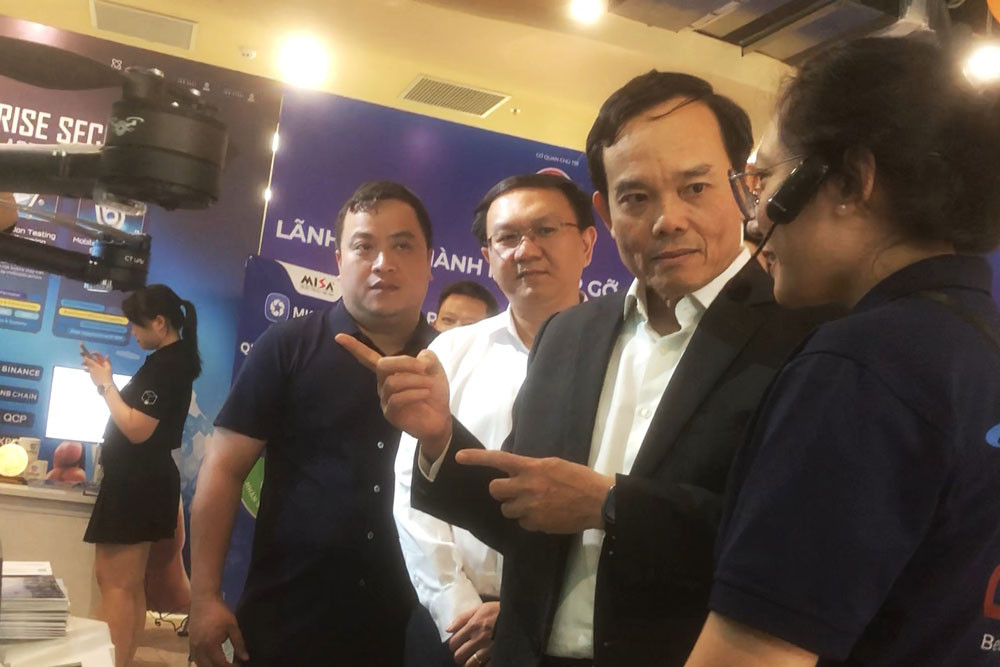
Mr Tran Luu Quang visits the exhibition booths showcasing technology products from enterprises during the HCMC leadership’s meeting with the science, technology and innovation startup community on the afternoon of December 9. Photo: Quốc Ngọc
She also emphasized the importance of organizing annual science and technology forums to communicate the city’s message to the world. A concrete example of such collaboration emerged just a few days before the meeting with the Party Secretary, when Ms. Mai announced that she had finalized six research topics valued at more than 20 billion VND with Dr. Luong Viet Quoc. This demonstrates the effective synergy between universities and businesses.
Listening attentively and taking notes of every comment, Party Secretary Tran Luu Quang concluded by affirming that the development of science and technology is an imperative task, not only to drive growth but also to address urgent public issues such as traffic congestion, flooding, pollution and the goal of achieving “zero drugs.”
“If we are able to advance science and technology, it will in turn provide us with the tools to resolve the challenges we are currently facing,” he remarked.
Regarding the specific proposals, Party Secretary Tran Luu Quang expressed his support for developing the low-altitude economy (LAE) and UAV manufacturing, considering them highly feasible.
Particularly in terms of sandbox mechanisms and financial support, the Party Secretary of Ho Chi Minh City gave strong commitments. For example, the city will offer tax incentives and waive various fees for any organization willing to establish venture capital funds in the fields mentioned above, with the expectation that the city will ultimately gain far more in return.
At the end of the meeting, the Party Secretary assigned concrete responsibilities to two advisory bodies. The Department of Science and Technology will serve as the primary coordinator, while the Ho Chi Minh City Institute for Development Studies will be in charge of proposing institutional frameworks, incentives, and most importantly, the roadmap and priority sequence.
Finally, Party Secretary Tran Luu Quang delivered an emotional call to action to the scientific and business communities:
“If we dream, we must dream big. Let us dream together of transforming Ho Chi Minh City into a center of innovation. And to achieve that dream, we must begin with the smallest, most concrete steps starting tomorrow.”
The Low-altitude Economy (LAE) is an emerging economic ecosystem focused on activities and services conducted within a certain lower layer of airspace (typically below 1,000–3,000 meters). In essence, LAE leverages technologies such as drones (UAVs), electric vertical take-off and landing aircraft (eVTOL) and related systems to create value across sectors including agriculture, logistics, transportation, surveillance, rescue, healthcare and entertainment. LAE is expected to become a powerful new driver of growth and digital transformation.
________________________
Follow CT Group on Facebook for the latest updates and news!